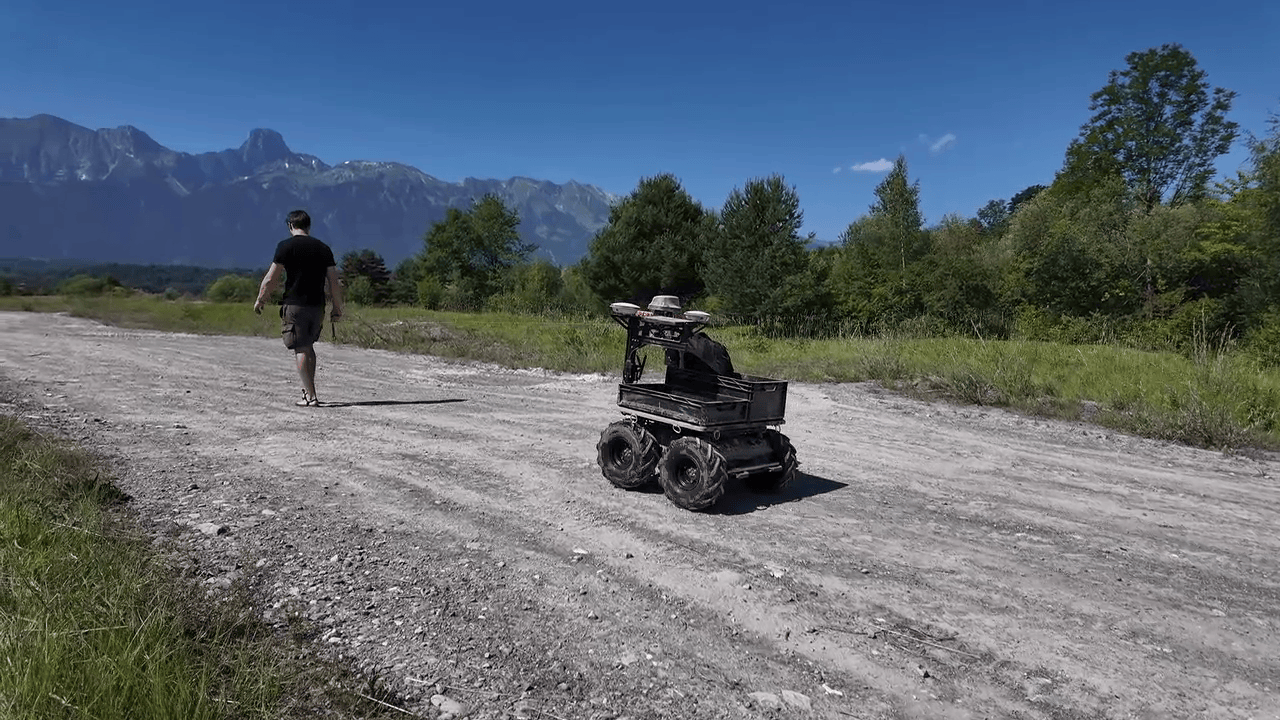
Our ELROB 2026 configuration, set up for outdoor logistics. Follow Me is the tether module. The cargo box, the Outdoor Navigation Package and the custom colour are separate options.
Follow Me
Clip in. Walk. It follows.
Follow Me connects the operator to the robot with a physical tether. Clip the endpoint to a belt loop, harness or pack strap with the carabiner, or just hold it, and walk. It is light enough to clip to clothing and sealed against rain and dust. Two encoders measure distance and angle continuously, and the robot follows the endpoint at a set standoff.
There is no radio in the follow loop. Nothing to jam, nothing to spoof, nothing to lose when the operator steps behind a wall. Because the measurement is mechanical, it works the same in darkness, dust, fog and falling snow, where camera and LiDAR based person-following degrades or stops. It also emits nothing while it does so: no illuminator, no scanning laser, no radio link.
Follow Me is a complete package on its own: it does not need the navigation package to work. Its safety layer is the mechanical release and stop described below. Obstacle detection is a separate option. Load the robot and it carries your gear: the platform is rated for 120 kg on Panther and 65 kg on Lynx, less the mass of whatever you fit. Add the Outdoor Navigation Package and the same walk becomes a taught route the robot replays without an operator.
Follow Me is available through our Field Evaluation Program rather than general order. The system is built and working. We ran it at ELROB 2026 to teach the route for a live competition run, in competition conditions, in June 2026.
We are placing it with a small number of selected operators to validate it across terrain, climates and mission profiles we cannot reproduce ourselves. Participants get the hardware early, direct access to the engineers who built it, and real influence over the release specification. In exchange we ask for structured feedback from actual use.
Commercial terms are agreed individually, because what each participant contributes differs. Tell us your use case and we will tell you what taking part would look like for you.
Parameters below are measured on current hardware and may still change before general release.
120 kg
Panther rated capacity, 65 kg on Lynx
0
radio links in the follow loop
5 m
tether working radius
2 m/s
following speed on Panther, 1.5 on Lynx
Why a tether
Person-following is a solved problem right up until the conditions get bad, and outdoors the conditions get bad.
Vision-based following needs to see the operator. It degrades at night, in dust, in fog, in falling snow, and when the operator's silhouette changes because they put on a pack or a coat.
Radio-based following, whether UWB tags, GNSS trackers or RF beacons, needs a link. Links can be jammed, spoofed, saturated, or blocked by terrain and structures. Where that matters, the link is a liability.
A tether is a physical measurement. Distance and angle come off two encoders. There is no signal to lose, no image to interpret and no bandwidth to contend for.
Three consequences worth knowing:
Nothing for the operator to wear, charge or lose. No tag, no beacon, no transmitter, no battery. You clip on a tether.
Wheel slip does not accumulate. Your position is measured on the tether, not inferred from how far the wheels turned. On mud, snow, gravel and loose sand, where odometry drifts, the reading stays true.
Almost nothing to detect. No illuminator, no scanning laser, no radio traffic between operator and robot. The follow function has no emissions to detect, unlike a camera or radio follower, which matters where that matters.
The trade-off is real: the operator is physically connected to the robot, and the working radius is the length of the tether. For the load-carrying missions this is built for, that costs nothing, because the operator is walking the route anyway.
How it works
- Clip in. Attach the tether endpoint to a belt loop, harness or pack strap with the carabiner, or hold it in your hand.
- Walk. The robot keeps the tether taut, so you feel a light constant tension as you go. Two encoders measure how much cord is paid out and which way it points, which is the operator's position in polar coordinates, read directly off the tether.
- It follows you, or it follows your path. In direct mode the robot holds a set distance and bearing behind you. In path mode it retraces the line you actually walked, smoothed, so it goes around what you went around. The modes are switchable, and path mode is what you want in terrain where the straight line between you and the robot is not drivable.
- Stop when you stop. The robot holds its standoff rather than closing on you.
- Optionally, teach. With the Outdoor Navigation Package fitted, the walked path is recorded as a drivable route the robot can replay autonomously, as many times as the mission requires.
Safety
The cord can release from the operator, whether they let go deliberately or the clip detaches.
Either way, the robot stops rather than carrying on unguided. A released cord retracts sharply, and the spool encoder registers that at once. This is a mechanical measurement, not a perception one, so it behaves the same in daylight, in darkness and in dust.
Obstacle detection is a separate, optional layer. The base package does not watch the path ahead: the operator chooses the route and the robot follows it. Order the robot with a distance sensor, or with the Outdoor Navigation Package, and it will also stop for obstacles in front of it. Both configurations are sold, so be explicit about which one you need.
Both platforms also keep their own hardware E-stop on the robot, independent of any package (Panther, Lynx).
Follow Me provides operational safety functions. It is not a certified functional-safety system and carries no performance level or safety integrity level rating. The operator chooses the path and stays responsible for picking a route the robot can drive. Deployments around other people require your own site risk assessment.
Specifications
| Following principle | Mechanical tether, two encoders measuring distance and angle |
| Follow modes | Direct, holding a set distance and bearing, or path, retracing the line the operator walked. Switchable |
| Tether working radius | 5 m as configured. The encoder assembly is available with a longer or shorter cord |
| Maximum following speed | The platform maximum: 2 m/s on Panther, 1.5 m/s on Lynx |
| Standoff distance | 1.5 m to 3 m, configurable |
| Operator interface | Tether endpoint with a carabiner. Clips to a belt loop, harness or pack strap, or is held in hand |
| Operator link protection | The clip releases under excessive load and the robot stops when the cord releases |
| Obstacle detection | Not in the base package. Available with a distance sensor or the Outdoor Navigation Package |
| Ingress protection | IP66 |
| Mounting | Anywhere on the platform. Centre front works best, and it sits alongside the Outdoor Navigation Package |
| Load carried | The platform's rated capacity, 120 kg on Panther and 65 kg on Lynx, less the mass of what you fit |
| Platforms | Panther, Lynx |
| Works standalone | The navigation package is optional, and adds route teach-in and autonomous replay |
| Availability | Field Evaluation Program. Selected operators, not general order. Terms agreed individually |
| Intellectual property | Patent pending |
Module weight is not published yet, because the mechanics are still being refined. It is light, and the figure goes here once it is settled.
Field record
At ELROB 2026, the European Land Robot Trial, we used Follow Me to teach the route for the Transport-Mule scenario: roughly 300 m between two points in non-urban hill terrain in Switzerland, among the 21 teams in the field, alongside Diehl Defence, Rheinmetall, L3Harris and TNO.
The operator walked the course once on foot. Panther then shuttled it autonomously using the Outdoor Navigation Package. One full cycle completed with one terrain-related safety intervention on a steep section, and a second cycle was stopped by a barricaded gate. Replanning around a blockade like that was part of the trial, but it is outside the scope of this package today.
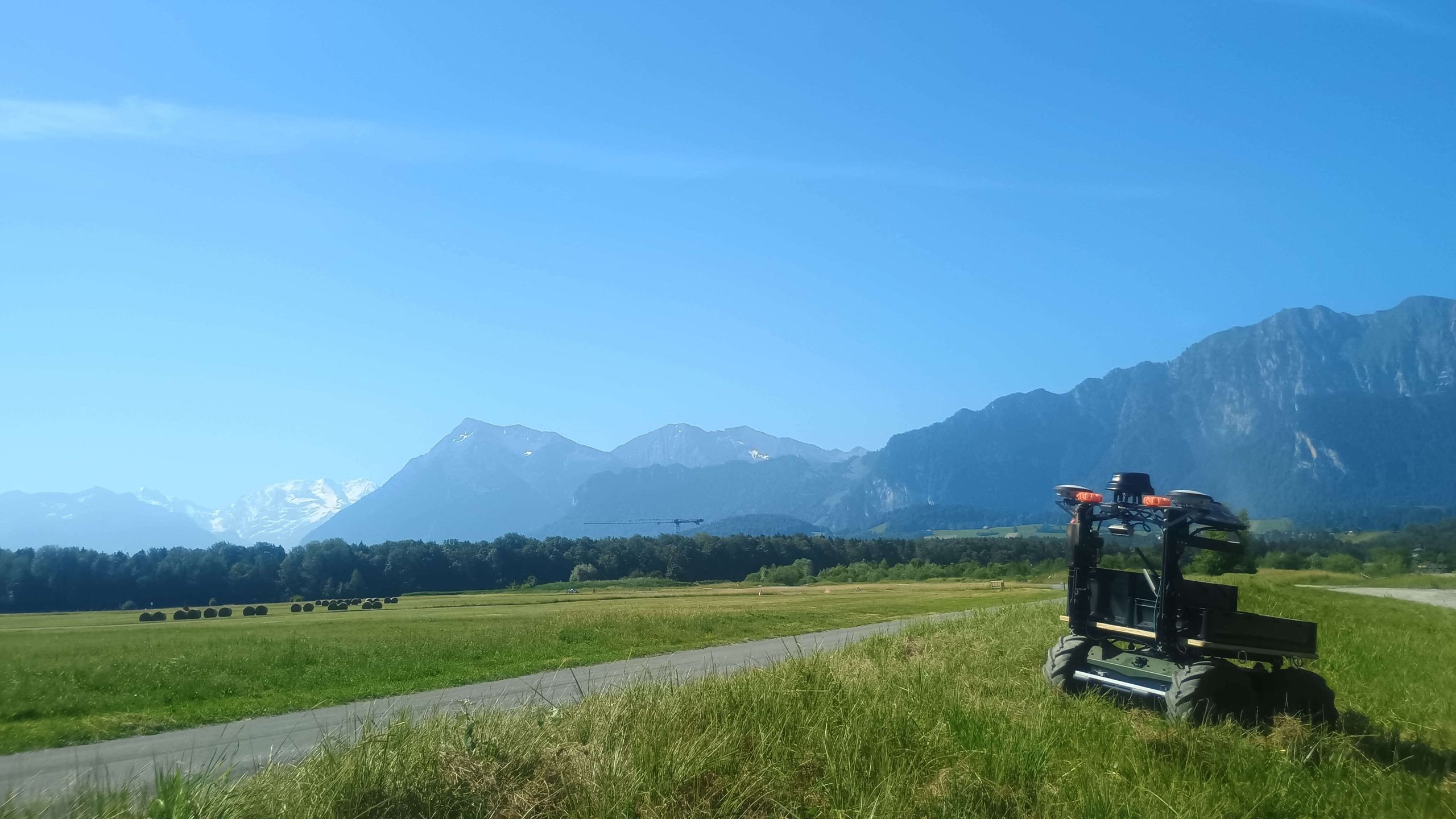
The same configuration carrying cargo during the Mule run.
Typical use
- Dismounted load carriage. The robot carries equipment, water or tooling behind a walking team.
- Route teach-in. The fastest way to give a robot a drivable route is to walk it once. Nothing to survey, draw or enter by hand.
- Degraded visual environments. Night work, dust, smoke, fog, snow.
- Environments where emissions matter. The follow function emits nothing: no light, no laser, no radio.
What it does not do
The tether is a physical link, so the failure mode is physical: the cord can snag on scrub, branches or rock. We have not hit it on the graded and semi-graded paths these missions typically use, though our sample is still small. When it does happen the clip releases and the robot stops rather than dragging anything. It is worth knowing before you plan a route through dense undergrowth.
The base package does not see obstacles, and the working radius is the 5 m of cord. Neither is a limitation you design around so much as a description of what the product is: the operator picks the line, and the robot carries the load along it.
Combines with
| Outdoor Navigation Package | Turns a walked route into an autonomously replayable mission. This is the pairing we field-tested at ELROB 2026 |
| Configuration options | Cargo boxes, gates, raised covers and mounting plates for the load you actually carry |
Apply to the Field Evaluation Program
We are not selling Follow Me to everyone yet. We are choosing a small number of operators to run it in conditions we cannot create in Poland, and we would rather get that group right than get it large.
You are a good fit if you move loads on foot over real terrain, on a route you walk regularly, and you are willing to report back on what breaks and what annoys you. Defence, forestry, construction, survey, utilities, agriculture and search and rescue are the profiles we are most interested in.
You get hardware ahead of general release, direct access to the engineers who designed it, and influence over the release specification. We will ask for structured feedback from real use, and permission to fix things based on it.
Terms are set case by case rather than from a price list. Some participants buy, some evaluate on other arrangements, and it depends on the environment you can give us access to.
If you need something in production today, say so in the form. Panther and Lynx are shipping and the Outdoor Navigation Package is orderable now: drive the route once by hand and the robot will replay it autonomously. That covers a good number of the jobs people come to Follow Me for, without the tether.